Noss

The Perfect Island For Birds

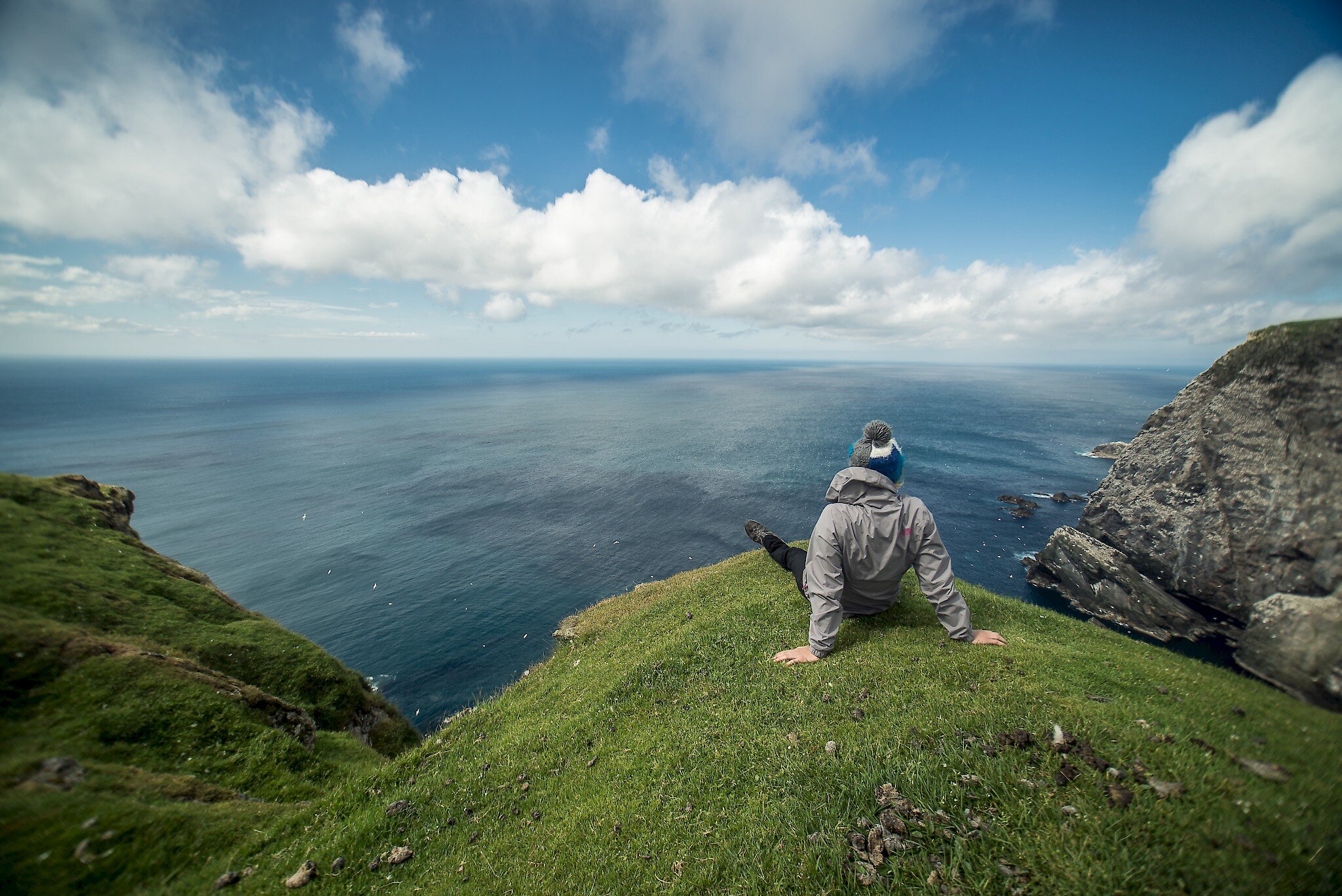
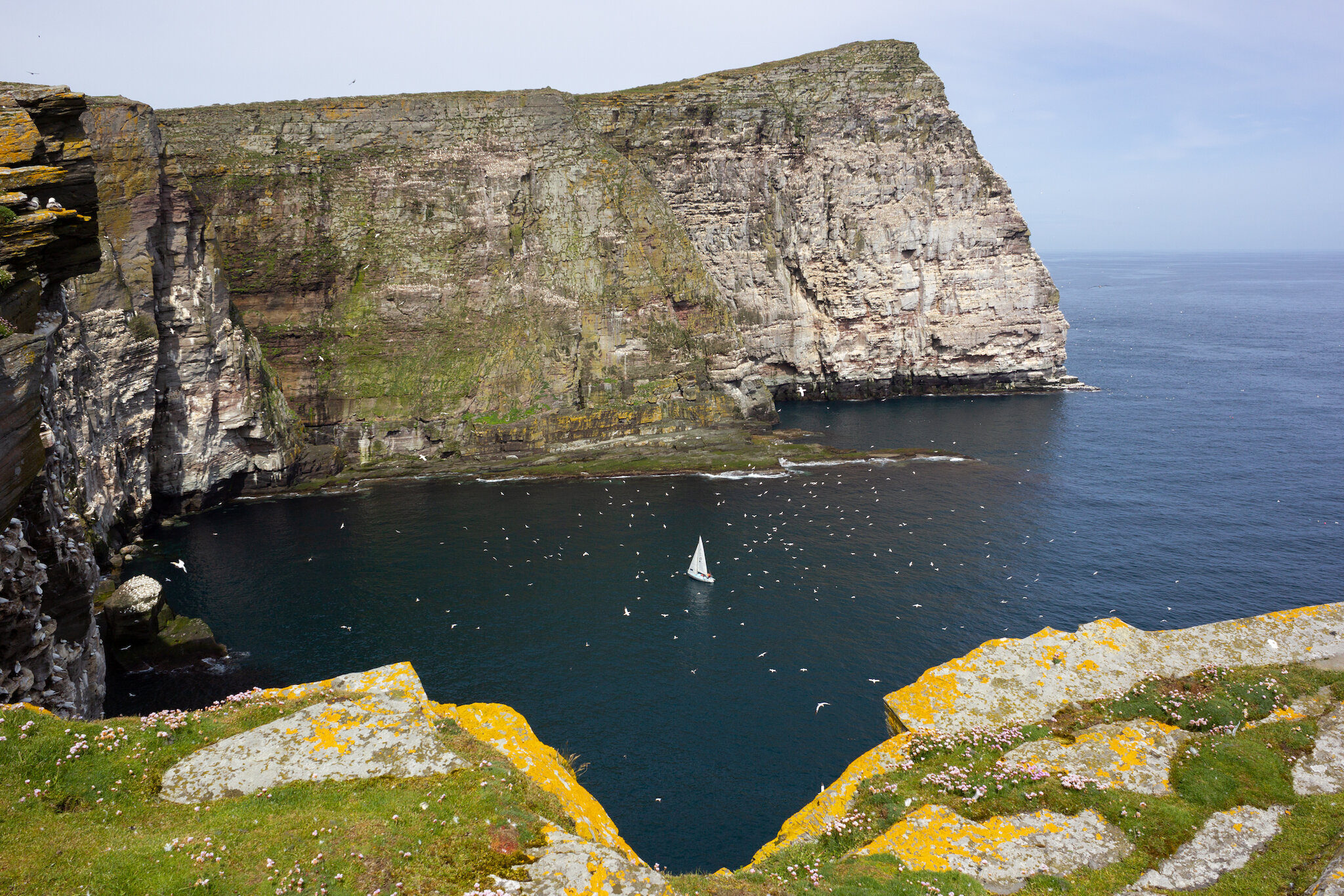
As soon as you set eyes on the mile-long seabird cliffs of Noss you can see why the island was declared a National Nature Reserve in 1955: this is one of the most spectacular wildlife sights anywhere.

At the peak of the breeding season the stupendous chorus of around 150,000 birds and chicks is unforgettable - as is the smell of the guano which stains the cliffs white! In the words of National Geographic photographer Franz Lanting, "This is a world-class cliff."

Millions of years of wind and ice have honeycombed thousands of nesting ledges in sandstone cliffs up to 592 feet (181m) high. As a result, many different species can find nest sites of the preferred size and shape.

Although not the biggest seabird colony in Britain, Noss is the most accessible one, combining very large numbers of birds with a wide variety of species and spectacular scenery.

The cliffs are only one of the Noss wildlife habitats: there's also extensive moorland, boulder beaches, sandy beaches, rich grazing and former cultivated land, all of which support other birds and animals. Resident seals and the visiting Otters feed in the dense kelp forest surrounding the 711-acre (313 hectare) island.

How To Get There

There are two very different ways to experience Noss and many visitors choose to do both:

Excursion boat from Lerwick. This is easily the best way to view most of the seabird nesting sites at close range (and the only way when the island is closed to visitors) but it doesn't include a landing on Noss. If you have mobility problems you can still see this wonder of the wildlife world: wheelchair users are welcome on a highly manoeuvrable boat with twin engines which can take you safely into the coves, right alongside the lower cliff ledges and, in calm weather, even into the Cave of Noss, with an underwater camera to explore the kelp forest as well. Details of daily sailings from the VisitScotland Information Centre.

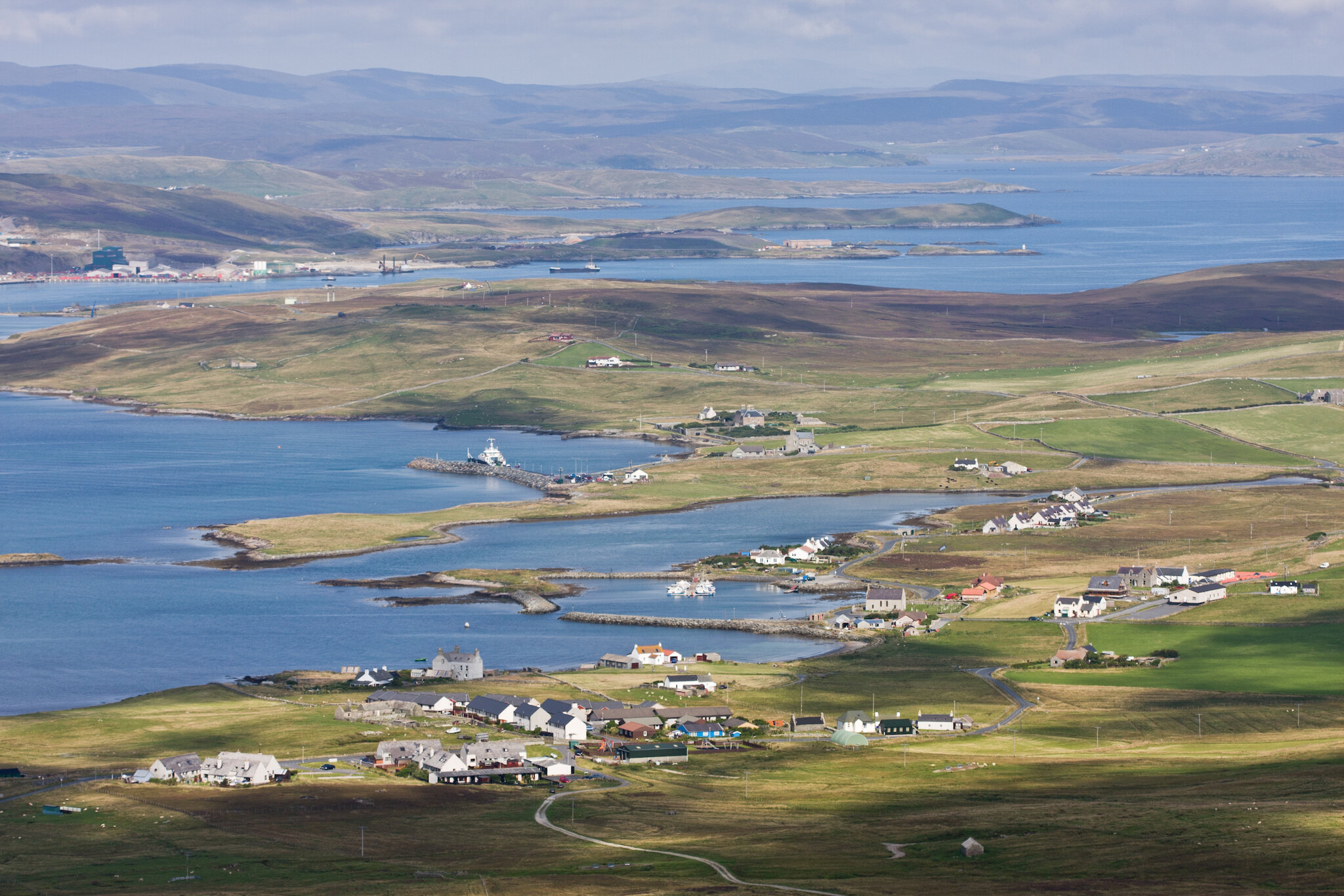
The Noss Sound ferry operates five-days-a-week (not Mondays or Thursdays) during the summer season (mid-May to late August) while the wardens are living on the island. You first take the Bressay ferry from Lerwick, then walk or drive the three miles (5km) across Bressay to Noss Sound where the ferry, a small inflatable boat with an outboard motor, will take you across the narrow sound to the Noss landing place at Gungstie.

The warden's house, Hametoun (also known as Gungstie, although that name properly applies to the boat landing), has a visitor centre with displays on the history, geology and ecology of the island, with information about the latest sightings. After the warden's briefing on safety and how to avoid disturbance to birds and livestock, you can follow the track around the edge of the island. Leave at least four hours for your walk - it's steeper than it looks and watching the Puffins on the clifftop may well delay you, to say nothing of that sensational aerial view of the gannetry.

Arctic Sandstorms and Giant Waves

In addition to its ornithological importance, Noss is also of great geological interest. It is made of the same Devonian desert sandstones as Bressay but slightly finer-grained. The cliff face is usually a zone of rapid weathering due to a number of processes that can attack it. There are three types of weathering: physical (eg. frost actions), chemical (involves hydrolysis) and biological (eg. growth of lichen or large amounts of guano). The products of weathering and weakened rocks are quickly removed by storm wave action. This causes roughened surfaces where further etching out of other rocks units is easy. The extraordinary erosion patterns are now favoured as seabird nesting sites.

Noss Sound is a relatively new channel and was probably made by storm waves that breached the sandy spit that once joined Noss to Bressay. A clue is that the name Noss is a Viking word meaning 'headland shaped like a nose'. If it had been an island when they arrived in the ninth century they would certainly have recorded the fact in their name for the place and it would be 'Nossay' - 'island shaped like a nose'. There are physical traces of a gigantic wave along the Bressay coast south of Noss Sound, and also a legend of a clifftop croft washed out by the sea at Stobister.

The Cliff Gardens of Noss

Because the grazing on Noss is restricted (and because even Shetland sheep can't find their way everywhere) the cliff vegetation of Noss is more luxuriant than in more heavily grazed areas, despite the plague of rabbits which each winter's cull only just keeps in check.

In early summer, as the Sea Pinks and blue Spring Squill fade, the cliffs present a palette of white Sea Campion and Scurvy Grass, Red Campion, yellow Birdsfoot Trefoil and Roseroot and the distinctive blue of Sheep's Bit Scabious, to set off the brown Heather moorland with its patches of Cotton Grass, Lousewort and orchids.

A Fertile and Productive Island

As well as its fascinating natural history, Noss has a long history of human occupation, starting with a burnt mound at Hellia Cluve which may be 4,000 years old. Place name evidence and the remains of a mediaeval chapel on Big Ness ('promontory of the buildings') suggest that Noss was home to a Celtic Christian community before the Viking invasion. What those marauders did to the priests in Papil Geo ('the Priests' Cove') may be imagined. From time to time, winter storms shift the sands at Nesti Voe to reveal human bones from the ancient graveyard.

The sandy soils around the 17th century house at Hametoun were easy to work - and to fertilise with seaweed from beaches such as Da Stinkin' Geos ('the smelly coves' where storm-blown seaweed lies and rots to this day). In subsistence times Noss was a very productive island, where good crops of oats and barley could grow and the grazing was so good there was even a milk surplus to make cheese.

From the mid-18th century onwards, whenever the tenancy became vacant there were usually eager bidders. Signs of that relative prosperity are still visible in the long, slightly curved 'rigs' on Turr Ness - the traces of ploughing by oxen which were swum across the sound from Bressay at low tide and herded at night in Da Owsen's Pund (the oxen's enclosure') at the north end of the big cliffs. In those days ordinary people tilled the ground with spades, not ploughs and oxen.

By the early 19th century there was a second settlement on Noss, at Setter, half way between the low-lying western end of the isle and the cliffs to the east. By 1861 the population peaked at 24, but may have included some visiting fishermen who spent the census night in summer lodges at Booth's Voe.

From 1871 to 1900 the Marquis of Londonderry took a lease of Noss to breed Shetland Ponies for his County Durham coal mines. A display in the old Pony Pund tells the story of this rather cruel trade, which also involved building a stone wall around the higher cliffs to stop the mares falling over. The stallions were kept in Bressay until required.

Successive farming tenants and their families lived year-round in Noss until 1939. After that it was occupied in summer only until 1969 when the last resident tenant (who was also honorary RSPB birdwatcher and ferryman) gave up the lease. Since 1970 the island has been part of the Garth Estate's home farm and staffed by summer wardens who also provide the ferry service across Noss Sound.

Notes for 'Nossers'

• Noss is open to visitors during the summer( except on Mondays and Thursdays) and closed in winter (September to mid-May)

• Boat trips which don't land on the island can visit Noss on any day of the year if the weather is suitable.

• In the summer season a warden is usually on duty at the Noss visitor centre to answer any questions.

• It is also possible to arrange guided tours with groups.

• If the weather's too bad for the Scottish Natural Heritage ferry to cross Noss Sound the wardens hoist a red flag outside their house but to avoid disappointment you should check with the VisitScotland Information Centre before setting out for Noss.

• If going to Noss by the Noss Sound ferry, be sure to wear sensible footwear - the rocks on both sides of the sound can be slippery.

• Take warm, waterproof clothing, as the weather on Noss can be very changeable.

• Visitors' dogs are not welcome. Even well-trained dogs can disturb wildlife and sheep.

• Don't leave litter - it can kill or maim wildlife.

• Don't take plants, eggs, birds or animals - only photos.

• Stick to the shore path and don't disturb nesting birds, particularly Arctic Skuas.

• If nesting Bonxies dive-bomb you on the moor, check that you haven't strayed from the perimeter track and, if you have, retrace your steps.

• Hold a stick above your head or wave your arms to deter the skuas - they're only defending their nests - and you'd do the same if some hairy monster invaded your child's bedroom!

For more information see the SNH Noss website. Contact: Scottish Natural Heritage, Ground Floor, Stewart

Building, Alexandra Wharf, Lerwick, Shetland. ZE1 0LL. Telephone (01595) 693 345.